
Clear Your Vacated Office Space and Redirect Every Asset Before the Lease Expires
FF&E redistribution, donation routing, and disposal managed under one engagement.
Schedule a site walk
No costTell us your lease-end date and we'll build the clearance plan around it.
Insured and bonded for managed commercial properties. US DOT 1691575 · CA PUC MTR0191887
FF&E Redistribution and Office Clearance for Los Angeles Businesses Transitioning, Downsizing, or Closing a Location
Commercial repurposing services handle what happens to your furniture, fixtures, and equipment after the decision to vacate is made.
FF&E - Furniture, Fixtures, and Equipment - is the category of movable commercial assets not permanently attached to a building. Desks. Task chairs. Filing systems. Conference tables. Monitor arms. Breakroom appliances. When a Los Angeles business downsizes, consolidates locations, or closes a site entirely, every piece of FF&E needs a decision.
Some of it goes to the new location. Some gets stored. Some gets redirected to another company, a nonprofit, or a donation partner. Some gets disposed of properly. The problem isn't knowing that these decisions exist. The problem is executing all of them simultaneously while managing an active relocation and a hard lease-end date.
That's what commercial repurposing services are built to do. Presto Movers handles FF&E receiving, redistribution, and clearance as a named service - not a side function of a standard move. This page exists because asset disposition and physical removal are two different logistics problems, and most facilities teams are staffed to manage one of them at a time.
Clearing Commercial Spaces in Downtown LA, Century City, Pasadena, and the Inland Empire
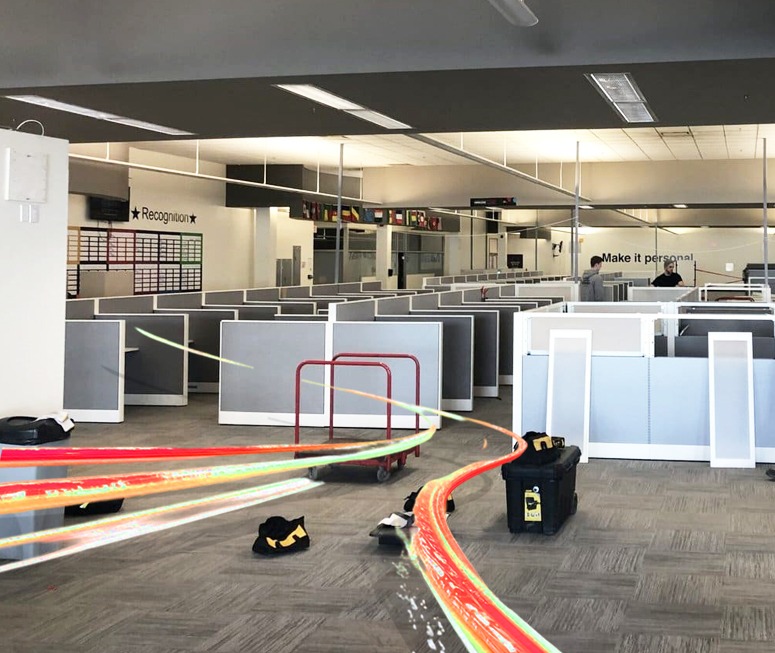
Presto Movers has cleared and redistributed commercial FF&E across Los Angeles County and into the Inland Empire since 2007.
The office markets we work in most frequently share a common challenge: high-rise and mid-rise buildings with strict freight elevator scheduling, narrow dock windows, and building management teams who require documentation before a single piece of furniture moves out. Downtown LA, Century City, and Pasadena all operate this way. So does the Ontario and Rancho Cucamonga corridor in the Inland Empire, where warehouse-adjacent office campuses often have different access rules entirely.
Our crews dispatch along the 101 and 210 corridors from our Simi Valley operations base. That positioning lets us reach Century City and Pasadena office markets efficiently - and connect directly to the Ontario and Fontana industrial corridor where redistribution partners and storage facilities cluster. That's not coincidental. It's how we built the route structure to support commercial clearance projects across the full LA basin.
Freight elevator reservation windows are often the actual scheduling constraint - not crew availability, not truck capacity. We pre-clear building access before any clearance date is confirmed.
The Lease-End Clearance Project Most Facilities Teams Need a Partner to Execute
A Century City consolidation showed exactly where the FF&E problem surfaces - about three weeks into a timeline that needed six.
The company was merging two floors into one and closing a Pasadena satellite office simultaneously. The relocation of core furniture and workstations to the new location was straightforward. What caught the facilities team off guard was everything else.
The conference room furniture didn't fit the new floor plan. Roughly sixty task chairs were surplus. Two rows of filing cabinets contained archived physical records that hadn't been reviewed in years. There were twelve large-format monitors on rolling carts, a decommissioned server rack, and two refrigerators in a breakroom that the new landlord wouldn't accept as building property.
That's decommissioned office inventory - the furniture, equipment, and fixtures removed from a commercial space being vacated or reconfigured. The facilities team had a plan for the move. They had no plan for any of this.
Presto Movers ran a same-week site walk and categorized every item: what moved, what stored, what donated, what disposed. We coordinated with a nonprofit partner in the San Gabriel Valley that accepted the task chairs and filing cabinets. The monitors went to a local school district through a donation routing arrangement. The server rack and refrigerators were disposed of through compliant channels - LA County's waste diversion rules prohibit dumping certain materials through standard waste streams.
The lease-end date held. The building passed inspection. Nothing was abandoned.
That's what this service actually involves - not just a truck and a crew, but a project with stakeholders, deadlines, and liability on every decision.
Every Asset Category Has a Destination - We Make Sure Nothing Gets Left to Default Disposal
Asset disposition - deciding what happens to each item - is a project management function, not a moving function.
Many commercial clearances default to disposal because no one had time to think through the alternatives. That's a capacity problem. When you're managing a relocation and a lease-end simultaneously, the path of least resistance is a dumpster. In Los Angeles, that path carries real costs.
LA County waste diversion requirements restrict what goes into standard waste channels. Disposing of certain materials incorrectly creates liability. More practically: furniture that gets dumped is furniture you paid for - and replacement cost at the new location may exceed the cost of proper redistribution.
We bring structure to the disposition decision. Every item category gets a routing plan before clearance day begins. Nothing defaults to disposal because no one had a better answer in time.
What Happens to Each Category of Asset: Keep, Store, Redistribute, Donate, or Dispose
Every piece of FF&E in a vacated space falls into one of five categories - and each category has a different execution path.
Here's how we work through the decision logic on a commercial repurposing project:
- Keep and Move
- Furniture and equipment confirmed for the new location. Tagged, protected, and transported as part of the relocation. This is standard moving work - we handle it without a separate vendor.
- Store
- Items the business wants to retain but can't place immediately. Short-term and long-term secure storage options are available. Climate-controlled storage - an environment-regulated facility that protects temperature-sensitive assets like electronics and artwork - is available for items that can't tolerate a standard warehouse environment.
- Redistribute
- Usable FF&E routed to another location within the company - a regional office, a warehouse, or a facility that can absorb surplus inventory. Space consolidation, the process of merging two or more office locations into one, often generates redistribution opportunities across a company's own portfolio.
- Donate
- Commercial donation routing - coordinating the transfer of usable office assets to nonprofits, schools, or qualifying recipients - requires scheduling, documentation, and a receiving partner who can take the volume. We manage all three, with established pathways across Los Angeles County and the Inland Empire.
- Dispose
- Lease-end clearance - the full removal of tenant-owned items before lease expiration to avoid holdover charges or penalties - has to account for compliant disposal, not just physical removal. We handle documentation for compliant disposal where required.
How a Commercial Repurposing Engagement Works From Initial Inventory to Final Clearance
A commercial repurposing project has three distinct phases - and the first one is where clearance outcomes are actually determined.
-
Phase 1: Site Walk and Asset Inventory
We schedule a site walk before any work is scoped or priced. Every item category is identified, counted, and assigned a preliminary disposition category. This is where the keep/store/redistribute/donate/dispose decision tree gets built. We flag anything requiring special handling - IT equipment, hazardous materials, oversized furniture, items with asset tracking requirements. Building access documentation and freight elevator scheduling begins in this phase.
-
Phase 2: Clearance Execution
Work begins by category, not by location within the building. Items moving to the new location are removed and transported first to avoid any mix with surplus inventory. Donation-routed items are staged separately and transferred to the receiving partner on a confirmed date. Storage-bound items are inventoried, wrapped, and transported to the appropriate facility. Disposal items follow compliant removal procedures, with documentation provided upon request.
-
Phase 3: Space Verification and Final Walkthrough
After clearance is complete, we walk the space with the facilities contact. The goal is a clean, empty floor ready for lease surrender - the return of a commercial property to the landlord meeting the conditions required to avoid holdover charges or penalties. If the building requires a move-out inspection, we coordinate our final walkthrough timing to support that requirement.
Commercial Repurposing and FF&E Services Across Greater Los Angeles and the Inland Empire
Presto Movers serves commercial clients throughout Los Angeles County and the surrounding region.
We run clearance and redistribution projects in Los Angeles, West Hollywood, Beverly Hills, Culver City, Burbank, Glendale, Santa Monica, Pasadena, Long Beach, Torrance, and the full Westside and San Gabriel Valley corridor. In the Inland Empire, we serve Ontario, Rancho Cucamonga, Fontana, San Bernardino, Riverside, and Corona. Ventura County clients in Thousand Oaks, Oxnard, and Ventura are also within our service area.
- Los Angeles
- West Hollywood
- Beverly Hills
- Culver City
- Burbank
- Glendale
- Santa Monica
- Pasadena
- Long Beach
- Torrance
- Ontario
- Rancho Cucamonga
- Fontana
- San Bernardino
- Riverside
- Corona
- Thousand Oaks
- Oxnard
- Ventura
Frequently Asked Questions
Something not covered? Call 888-678-6151 and we'll scope it with you.
How much does a commercial repurposing and FF&E clearance project typically cost?
Pricing depends on inventory volume, number of disposition categories, and building access complexity. A single-floor clearance with donation routing and disposal runs differently than a multi-site consolidation with storage and redistribution. We provide itemized quotes after the site walk - not before, because guessing without an inventory produces numbers that don't hold. Contact us at 888-678-6151 to schedule a site walk and get an accurate scope.
How long does the full process take from site walk to final clearance?
Most single-location commercial repurposing projects complete in one to three weeks from site walk to final walkthrough. The site walk takes one to two hours. Donation routing and storage booking require lead time - usually five to ten business days. The clearance execution itself is typically one to two days depending on floor size. Lease-end pressure is the most common timeline constraint, so we recommend contacting us 60 to 90 days before your expiration date.
What happens if some of our FF&E doesn't have a confirmed destination yet?
Every item gets a disposition category before clearance day begins. If a destination isn't confirmed for a specific category, we hold that inventory in short-term storage rather than default it to disposal. Nothing moves to a dumpster because a decision wasn't made in time. That's built into how we structure the project - the site walk exists specifically to resolve those open questions before execution starts.
Can't our facilities team handle this internally instead of hiring a vendor?
Most facilities teams can manage either the relocation or the asset disposition - rarely both simultaneously against a hard lease-end date. Donation routing requires a confirmed receiving partner with capacity. Compliant disposal requires documentation. Redistribution requires a destination and scheduling. When all of these run in parallel with an active move, the coordination load exceeds what an internal team is staffed to absorb. That's the gap this service fills.
How is this different from just hiring a junk removal company for the leftover furniture?
Junk removal routes everything to disposal. Commercial repurposing routes each asset category to its best outcome - keep, store, redistribute, donate, or dispose. For Los Angeles businesses, that distinction matters financially: improper disposal of certain materials violates LA County waste diversion rules and creates liability. It also matters practically - usable furniture donated through proper channels reduces replacement cost at the new location.
Does Presto Movers handle both the relocation and the FF&E clearance, or only one?
Presto Movers handles both under one engagement. The physical relocation of confirmed furniture to the new location and the clearance of surplus inventory are coordinated as one project, not handed off between vendors. We've served commercial clients across Greater Los Angeles since 2007 and are fully insured and bonded - a requirement for contractors operating in managed commercial properties with building access documentation standards.
Lease Ending Soon? Let's Map Out What Happens to Every Asset Before That Date
The site walk is where every commercial repurposing project starts - and earlier scheduling means more options for your team.
When your lease end is within 60 to 90 days, asset disposition decisions need to begin now. Donation routing requires a receiving partner with availability. Storage requires booking. Redistribution requires a destination. Disposal requires documentation. None of these happen on clearance day - they're planned before it.
Call Presto Movers at 888-678-6151 or email info@prestomovers.net to schedule a site walk. Tell us your lease-end date and we'll build the clearance plan around it.
Prefer a callback?
Pick a timeOr call 888-678-6151 directly. US DOT 1691575 · CA PUC MTR0191887